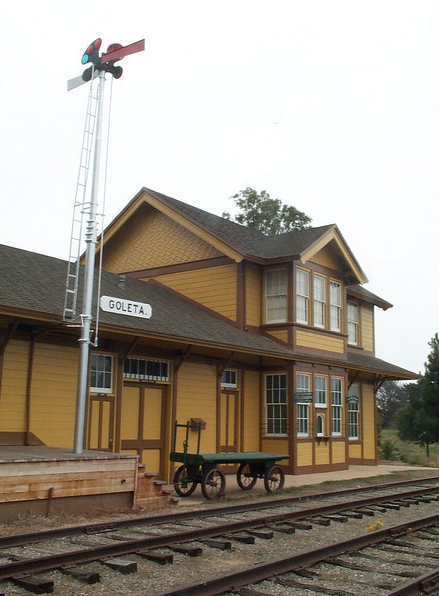
If you have visited South Coast Railroad Museum, you probably recognize Goleta Depot immediately: its yellow exterior, broad roof, trackside bay window and long freight-room section make it one of Goleta’s most distinctive historic buildings.
But there is something about the building that most visitors probably don’t know.
Goleta Depot was built from a Southern Pacific standard design known as “Combination Depot No. 22.”
So what exactly does that mean?
One Building, Two Jobs
The word “combination” describes one of the depot’s most important features.
Unlike larger city stations, which often had separate buildings for passengers and freight, rural railroad stations frequently combined both functions under one roof. Goleta Depot was designed to serve as both a passenger station and a freight terminal.
That made sense in a community like Goleta in the early 1900s. One building could handle passengers waiting for a train, tickets and railroad business, baggage, agricultural shipments and other freight moving in and out of the valley.
Southern Pacific called this particular standardized building plan Combination Depot No. 22.
A Southern Pacific Standard
Southern Pacific relied heavily on standard designs. Instead of designing every depot from scratch, the railroad developed plans that could be reused throughout its system.
And No. 22 proved particularly successful.
At least 100 Combination Depot No. 22 buildings and variations of the design were constructed between about 1893 and 1920 in California, Nevada, Arizona, Texas, Oregon and Utah.
Santa Barbara County was something of a hotspot for the design.
Eight No. 22 depots were constructed here — at Guadalupe, Surf, Lompoc, Concepcion, Sudden, Gaviota, Naples and Goleta. Seven stood along an 86-mile stretch of Southern Pacific’s Coast Line, while the Lompoc depot served a branch line from Surf.
Goleta’s depot was built in 1901 as Southern Pacific completed its new Coast Line through the area.
Standard Didn’t Mean Identical
Calling it a “standard design” doesn’t mean every No. 22 depot looked exactly alike.
Southern Pacific modified the basic plans to meet local needs. Some depots received larger freight rooms or waiting rooms. Interior walls could be moved or eliminated, plans could be reversed, and later examples even received different roof designs.
Goleta Depot itself is a surprisingly substantial building.
Its footprint measures approximately 25 feet by 92 feet, with roughly 3,500 square feet of floor space spread across three levels.
On the ground level were three principal railroad spaces: the Waiting Room, Freight Office and Baggage Room.
The Freight Office was the working center of the station. A ticket window connected it to the Waiting Room, while the distinctive trackside bay window gave the station agent a broad view in both directions along the railroad tracks.
That projecting window bay remains one of the building’s most recognizable features today.
It Wasn’t Always Yellow
Here is another surprise.
The familiar yellow exterior we associate with Goleta Depot probably wasn’t its original color.
When the depot was built in 1901, Southern Pacific was generally painting its country stations a slate gray. Around 1906, the railroad adopted a much brighter color scheme featuring “Colonial Yellow” walls, brown trim, white window sash and a green roof. Existing stations, including Goleta, were subsequently repainted to conform to the new standard.
So even something as familiar as the depot’s color tells another chapter of railroad history.
Designed to Work
Combination Depot No. 22 was not intended to be a grand urban railroad station.
Gary B. Coombs describes the design as a simplified or “carpenter” version of Victorian architecture, intended to have a familiar, almost residential appearance. Architectural details included broad eaves, decorative woodwork, double-hung windows and extensive use of California redwood.
It was attractive, but above all, it was practical.
For decades, passengers came through its Waiting Room. Railroad agents worked from its office. Freight passed across its platforms. And the building served as an important connection between the Goleta Valley and the larger world.
More than 120 years later, those same rooms and architectural features help visitors understand what a working rural railroad station was actually like.
That is one of the reasons preserving Goleta Depot matters.
The next time you visit South Coast Railroad Museum, take another look at the building itself. You aren’t simply looking at an old railroad station.
You’re looking at a surviving example of Southern Pacific’s Combination Depot No. 22 — a building designed more than a century ago to serve a growing community along California’s Coast Line.
This article is based on historical information from Goleta Depot: The History of a Rural Railroad Station by Gary B. Coombs, published by the Institute for American Research.