Forty-five years ago today, one of Goleta’s most recognizable landmarks did something buildings generally aren’t supposed to do.
It went for a ride.
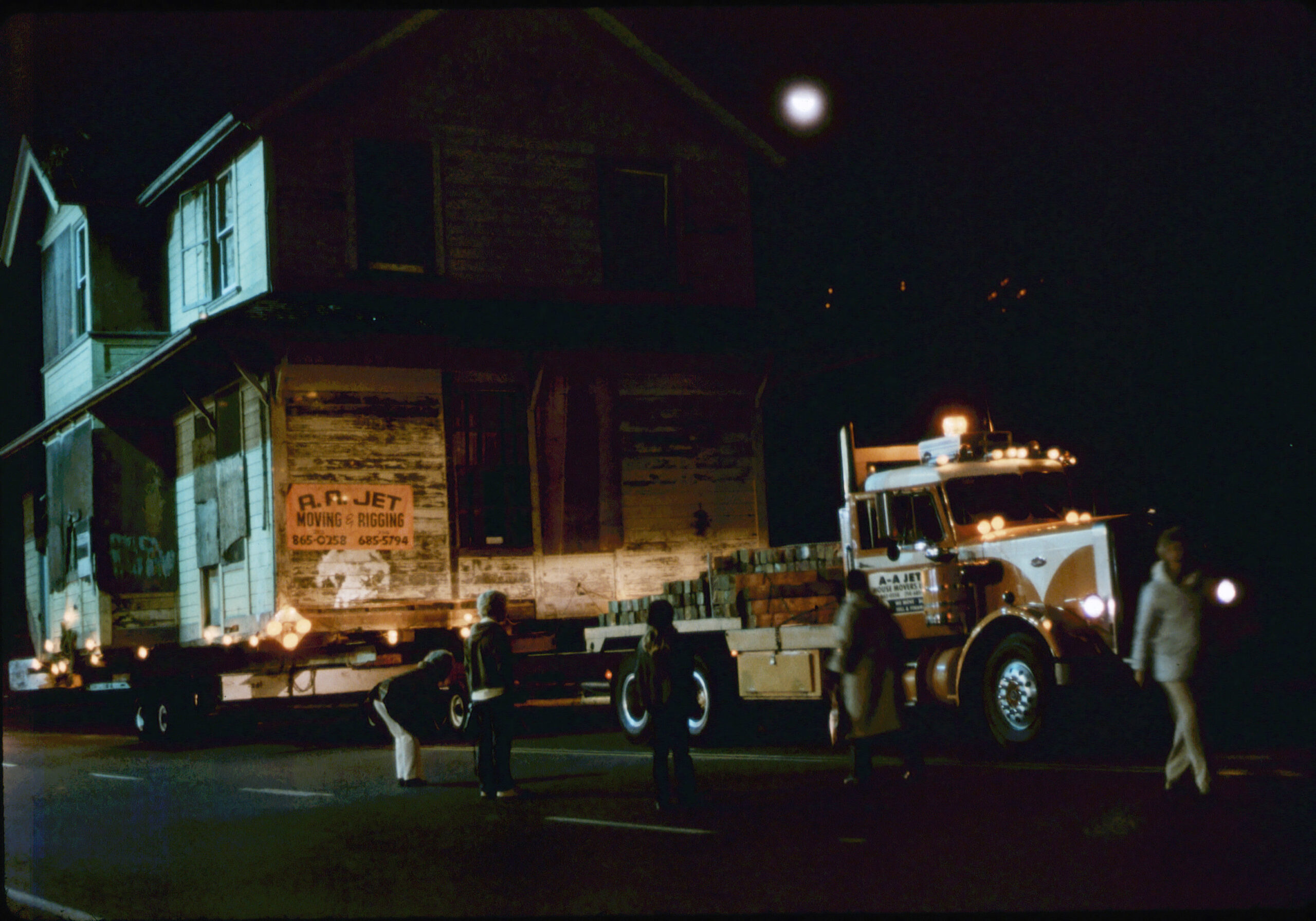
During the early morning hours of November 19, 1981, the historic Goleta Depot slowly traveled through the streets of Goleta toward a new home on Los Carneros Road.
The building had stood beside the Southern Pacific tracks for 80 years. By the time the sun came up that morning, the old station was gone from its longtime trackside location — and a new chapter in its life had begun.
Today, that building is the centerpiece of South Coast Railroad Museum.
But getting it here was anything but simple.
First, You Have to Move a 92-Foot Railroad Station
Saving Goleta Depot required relocating the entire building from its original site near South Kellogg Avenue to what was then Los Carneros County Park.
There was one immediate problem.
The depot was 92 feet long.
Moving it intact wasn’t practical, so professional movers from AA Jet Movers of Norwalk arrived on November 9, 1981, and began preparing the structure for its journey.

Their solution was dramatic: cut the building into two pieces.
The larger section measured about 60 feet long and weighed approximately 70 tons. It contained the entire second story, Waiting Room, Freight Office, Baggage Room and part of the freight warehouse.
The remaining 32 feet of the freight house became the second section.
Within days, both pieces had been lifted onto large trailer assemblies that would carry them through Goleta.
Meanwhile, volunteers, contractors, utilities and government agencies were preparing everything else.
Permits had to be secured. Telephone, electric and cable television companies had to coordinate with the movers. Roads and the new site had to be prepared. Trees along the route had to be trimmed.
Even the weather was a concern. Rain in the weeks before the move threatened to upset the carefully coordinated schedule.
Somehow, everything came together.

The Journey Begins
On the afternoon of Wednesday, November 18, the two sections made the first short portion of their trip.
They were moved about two blocks south to a field on the east side of South Kellogg Avenue between Hollister Avenue and the railroad tracks.
That first move took about two hours and helped get the enormous pieces past several utility lines near the original depot site.
Then everyone waited for nightfall.
Shortly after midnight, the real journey began.
The larger two-story section led the way, followed by the smaller freight-house section. Diesel-powered trucks pulled each piece, which had been decorated with red and yellow safety lights.
Gary B. Coombs later recalled that the illuminated buildings looked almost like enormous mobile Christmas trees moving through the night.
Imagine encountering that on your way home.
Wrong Way Down Hollister Avenue
From Kellogg Avenue, the convoy turned onto Hollister Avenue.
But this wasn’t a normal turn.
Traffic lights, signs and other obstructions hung above the roadway, so the depot entered Hollister on the wrong side of the street and continued that way for several blocks.

One member of the preservation committee, George Adams, accompanied the procession with a tape recorder playing the sounds of steam locomotives.
As the depot passed a bar on Hollister Avenue, one customer heard the train sounds and rushed outside, apparently thinking a freight train might somehow be heading toward downtown Goleta.
Then he saw what was actually coming down the street.
His reaction, preserved in Gary Coombs’ account of the move, was:
“Train, hell! The depot’s going by!”
Soon a crowd came out of the bar, cheering as the depot rolled past.
Some even threw loose change into the street.
Naturally, members of the Depot project picked it up for the cause.

Over the Freeway
At Fairview Avenue, the convoy turned north and faced another challenge:
The U.S. 101 overpass.
There were concerns about controlling the enormous weight of the building while climbing and descending the bridge — and even some worry about the effect that weight might have on the overpass itself.
But the depot continued without incident.
As the two sections crossed above the freeway, cameras flashed and motorists below honked their horns.
From Fairview Avenue, the convoy turned west onto Calle Real for the longest stretch of the journey.
And despite everything the old wooden building was being put through, it remained remarkably quiet and stable.
Wires, Roads and One Very Stubborn Oak Tree
The trip was far from over.
At La Patera Lane and Calle Real, the depot encountered a bundle of high-voltage lines that couldn’t simply be removed.
The movers had anticipated the problem.
A long wooden beam had been installed along the ridge of the two-story section’s roof. With electrical crews lifting the wires as high as possible, the building slowly passed underneath while the wires scraped across the protective beam.
Farther west, portions of the depot were actually wider than the roadway. Trailer wheels occasionally left the pavement and traveled along the shoulder.
Finally, the convoy reached Los Carneros Road.
The Depot was only about a block from its new home.
One last obstacle stood in its way.
A large oak tree stretched across the roadway.
The tree had already been trimmed twice in preparation for the move, but as the depot approached, it became obvious that there still wasn’t enough clearance.
The driver maneuvered the enormous two-story section as far to the side as possible, even putting wheels onto and beyond the sidewalk.
The depot squeezed through.
Its roof and eaves brushed against the tree branches, and one limb became lodged between an eave and the gutter.
The following morning, the building’s eaves still contained an assortment of branches and twigs collected from trees encountered along the route — evidence of just how close some of those clearances had been.
3:03 A.M.
At precisely 3:03 a.m. on November 19, 1981, both halves of Goleta Depot were finally off the street and safely on their new site.
More than 100 people had gathered when the late-night portion of the journey began. Despite the cold, dozens remained until the end.
Some had walked the entire route alongside the depot.
At 3:08 a.m., the trucks’ engines were turned off and the running lights went dark.
After years of uncertainty, fundraising, planning and preservation work, Goleta Depot had made it.
The relocation itself cost approximately $23,700, most of which went to the moving company, with the remainder covering the temporary relocation of utility lines.
But moving the depot wasn’t the end of the project.
In many ways, it was the beginning.

And the Next Morning, They Went Back to Work
Only a few hours later, something happened that says almost as much about the Depot story as the move itself.
Back at the old trackside location, volunteers were already at work.
Gene Allen, Nancy Reid and Mary Lou Williamson — two of whom had stayed with the depot until the end of the overnight journey — joined the effort to salvage bricks from the old foundation.
The bricks would be sold to raise money for the next phase: restoring the building.
That fundraiser eventually brought in more than $1,000.

Gary Coombs saw that morning’s work as representative of what had made the entire preservation effort possible: people willing to give their time and energy whenever another job needed to be done.
There was still an enormous amount of work ahead.
The two pieces of the depot had to be reunited. The building needed restoration and rehabilitation. The community would eventually transform the former Southern Pacific station into a museum.
But the building was safe.
45 Years Later
When Goleta Depot rolled away from its original site that November night, there was no guarantee of everything that would follow.
Yet 45 years later, the building is still here.
Children walk through the same Waiting Room where passengers once waited for Southern Pacific trains. Visitors stand in the Freight Office where railroad agents once conducted business. Families ride the Goleta Short Line just outside.
And every person who visits South Coast Railroad Museum walks into a building that survived because a group of people decided an important piece of Goleta history was worth saving.
The move of November 18–19, 1981 lasted only a few hours.
Its impact has lasted 45 years — and counting.
This article is based on Goleta Depot: The History of a Rural Railroad Station by Gary B. Coombs, published by the Institute for American Research. Coombs devoted an entire chapter of the book to the November 1981 move and the community effort that made it possible.